


 0
0
Spermidine and Exercise: Autophagy, Muscle and Aging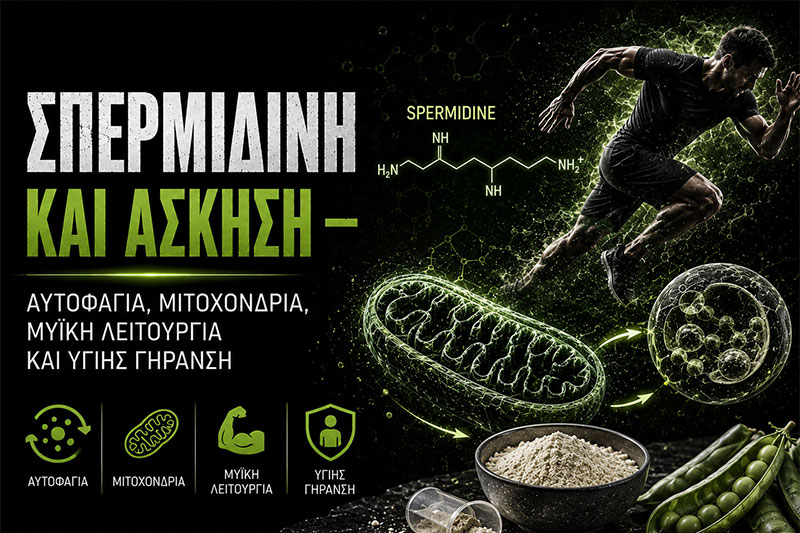 Spermidine is a naturally occurring polyamine produced by the body, generated by the intestinal microbiota and obtained from foods such as whole grains, legumes, mushrooms and certain soy foods. It participates in the regulation of cellular growth, protein synthesis and autophagy. Interest in exercise focuses mainly on muscle regeneration, mitochondrial function and the preservation of muscle health during aging. Most relevant evidence, however, comes from cells and experimental animals. Spermidine and AutophagyAutophagy is a physiological process through which cells remove or recycle damaged proteins and organelles. Proper regulation of this process is important for cellular homeostasis. Experiments involving yeast, worms and flies found that spermidine activated autophagy-related mechanisms and extended lifespan in these organisms. These findings generated interest in spermidine as a potential healthy-aging nutrient, but they do not demonstrate lifespan extension in humans. Eisenberg et al., 2009 Exercise also activates cellular recycling pathways. Spermidine and physical activity could theoretically have complementary effects, but such synergy has not been confirmed in human clinical trials. Mitochondria and Energy MetabolismMitochondria produce much of the energy required by skeletal muscle. Aging and physical inactivity may impair the mechanisms responsible for removing dysfunctional mitochondria. In a rat model of accelerated aging, combining spermidine with swimming was associated with improved markers of autophagy, better mitochondrial morphology and reduced muscle atrophy. This was an animal disease model and cannot be directly translated to healthy athletes. Fan et al., 2017 Spermidine supplementation has not been shown to increase energy production, maximal oxygen uptake or endurance performance in humans. Muscle Regeneration and RecoveryMuscle satellite cells become active following muscle damage and contribute to muscle-fibre regeneration. A 2024 study found that spermidine participated in satellite-cell activation through the spermidine–eIF5A axis and supported muscle regeneration in mice. These mechanistic, preclinical findings do not demonstrate faster post-exercise recovery in humans. Zhang et al., 2024 There is currently insufficient human evidence that spermidine reduces muscle soreness or accelerates the return to training. Muscle Growth, Strength and PerformanceActivating autophagy is not equivalent to increasing muscle mass. Hypertrophy depends primarily on resistance training, sufficient energy and protein intake and adequate recovery. In a 2025 study involving male mice, spermidine did not enhance overload-induced muscle hypertrophy. Mean muscle-fibre cross-sectional area decreased without a corresponding change in muscle wet weight. The researchers concluded that the effect on hypertrophy was absent or potentially suppressive. Iwata et al., 2025 There is currently no strong evidence that spermidine directly improves:
Spermidine and Healthy AgingA prospective population study associated higher dietary spermidine intake with lower all-cause mortality. As an observational study, it cannot establish that spermidine caused the association. Kiechl et al., 2018 In a randomized trial involving 100 older adults, 0.9 mg of spermidine daily for 12 months did not significantly improve the primary memory outcome or most secondary biomarkers compared with placebo. Adverse events were balanced between groups. The study did not assess athletic performance. Schwarz et al., 2022 Dosage and SafetyNo scientifically established ergogenic dose of spermidine currently exists. Doses used in animal experiments should not be converted directly into human supplementation protocols. Although a low supplemental intake was studied for 12 months without a difference in overall adverse events, evidence concerning higher doses and long-term use in athletes remains limited. People taking medication or managing a health condition should seek guidance from a healthcare professional. ConclusionSpermidine is an interesting research compound in relation to autophagy, mitochondrial quality and muscle regeneration. Preclinical findings are promising, but human evidence for strength, muscle growth, recovery and athletic performance remains insufficient. It should not currently be considered a confirmed ergogenic supplement or a substitute for exercise, balanced nutrition and sufficient sleep. FAQDoes spermidine increase autophagy?Autophagy activation has mainly been observed in cells and experimental animals. The magnitude of this effect in humans has not been fully established. Does it support muscle growth?There is no human evidence demonstrating increased muscle mass. One animal study found no enhancement of overload-induced hypertrophy. Can it improve athletic performance?It has not been shown to increase strength, power, endurance or maximal oxygen uptake. Can spermidine be combined with exercise?The combination has mainly been studied in experimental animals. Evidence for an additional benefit in exercising humans is currently insufficient. Is there an established dose for athletes?No. An effective or optimal ergogenic dose has not been established. Scientific References
|

Best supplements store
CHOOSE CATEGORY
CATEGORIES









(c) katerelosfitness.gr - All rights reserved - By: Hyper Center -