


 0
0





L-Citrulline Dosage, Timing, Safety and Side Effects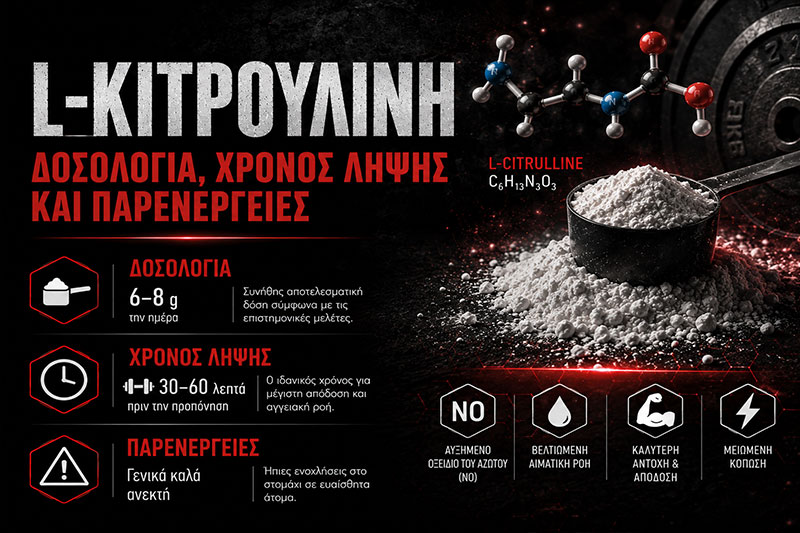 There is no universally established official L-citrulline dosage for sports use. Exercise studies commonly use approximately 3–6 g of pure L-citrulline or 6–8 g of citrulline malate, usually 45–120 minutes before exercise. Daily protocols have also tested 2.4–6 g of L-citrulline per day. These are research protocols, not personalized recommendations. A 2026 meta-analysis found that an optimal dose, ingestion time and target population have not been reliably established [1]. Is there an official recommended dose?No generally accepted recommended daily allowance or supplemental tolerable upper intake level has been established for L-citrulline. An appropriate amount may depend on the form, total formulation, intended use, duration, health status and concurrent medication. Amounts commonly found in research
These values are not an exhaustive list and do not guarantee an ergogenic effect. L-citrulline versus citrulline malate: why do the gram amounts differ?Pure L-citrulline contains citrulline alone. Citrulline malate combines citrulline with malic acid, so total mixture weight does not necessarily equal citrulline weight. If a verified 2:1 label describes a ratio by weight, 6 g of the mixture would theoretically provide 4 g of citrulline. With a verified 1:1 ratio, 6 g would theoretically provide 3 g. Commercial labels and actual composition are not always equivalent. Check the label for the amount of elemental L-citrulline per serving and, when available, independent composition testing. When should citrulline be taken before a workout?Acute trials commonly use a window of 45–120 minutes before exercise. A dose-ranging pharmacokinetic study documented increases in plasma citrulline and arginine after ingestion [2]. However, a trial using 6 g either one or two hours before exercise found neither a performance effect nor a timing advantage [3]. A newer trial using 5.3 g pure L-citrulline or the same citrulline amount plus 2.7 g malate 45 minutes before exercise also found no neuromuscular performance benefit [4]. Therefore, “60 minutes before exercise” reflects a common research practice, not a uniquely proven optimal time. Single-dose or daily use?The two approaches are not interchangeable. Acute use tests an immediate effect before a specific task; daily use aims for a more sustained change in arginine availability and related metabolites. In one randomized study, 0.75–3 g twice daily for one week dose-dependently increased plasma arginine. The highest amount affected nitric-oxide signalling markers but did not improve flow-mediated dilation [5]. Another small trial in trained men used 2.4 g/day for seven days and reported a modest improvement in a cycling time trial [6]. Mixed findings mean that a consistent protocol does not make L-citrulline predictably effective for every person. Safety and possible side effectsL-citrulline is generally well tolerated in short-term studies of healthy adults. Possible nonspecific effects include gastrointestinal discomfort, nausea, bloating, diarrhoea, headache or dizziness. Their frequency has not been established consistently, and the absence of symptoms in a small trial does not prove safety for everyone. A graded-intake study in 60 healthy men detected no treatment-related adverse effects at up to 24 g/day for four weeks and proposed that amount as the NOAEL for that protocol [7]. The finding is limited to healthy men, four weeks of exposure, and a study in which some authors were employed by amino-acid companies. It does not mean that 24 g is necessary, effective or suitable for long-term use. Blood pressure, medicines and special precautionsBecause L-citrulline can raise arginine availability and influence nitric-oxide signalling, caution is reasonable for people with low blood pressure or those taking antihypertensives, organic nitrates/nitrites or PDE-5 inhibitors. A small 2026 trial in 12 untreated hypertensive men reported lower blood pressure after 6 g/day for six days [8]. This does not prove a specific drug interaction, but it supports clinician or pharmacist review before combining these agents. Professional guidance is particularly important for:
Stop use and seek professional advice if persistent gastrointestinal symptoms, marked dizziness, faintness or another unusual reaction occurs. Practical pre-use checklist
ConclusionResearch has tested multiple forms, amounts and timing strategies, but has not identified one optimal L-citrulline dosage for everyone. Distinguishing pure L-citrulline from citrulline malate, calculating actual citrulline content and considering health status are more important than copying a single study dose. Short-term tolerability appears generally good in healthy adults, but evidence does not support unrestricted or prolonged use of high amounts.
FAQWhat is the correct L-citrulline dosage?There is no single official dose. Research often uses 3–6 g pure L-citrulline or 6–8 g citrulline malate, but these amounts are not personal recommendations. How long before training should it be taken?Many studies administer it 45–120 minutes before exercise. No single optimal timing point has been established. Are 6 g of L-citrulline and 6 g of citrulline malate equivalent?No. Citrulline malate also contains malic acid, so its ratio and actual L-citrulline content must be checked. Can L-citrulline be taken daily?Daily use has been studied for limited periods, but long-term safety data remain limited. Suitability depends on the individual and their medical history. What are the possible side effects?Possible effects include gastrointestinal discomfort, nausea, bloating, diarrhoea, headache or dizziness. Reliable incidence rates have not been established. Does L-citrulline interact with blood-pressure medication?Specific clinical interactions have not been fully characterized. Because L-citrulline may influence vasodilation and blood pressure, combinations with antihypertensives, nitrates or PDE-5 inhibitors should first be reviewed by a physician or pharmacist. References
|

Best supplements store
CHOOSE CATEGORY
CATEGORIES










(c) katerelosfitness.gr - All rights reserved - By: Hyper Center -